
A social media audit is four checks: a list of every account you own, a review of each profile, a read of your best and worst posts, and 90 days of numbers. That is the whole thing. Agencies wrap it in more syllables, but the work fits in an afternoon and needs nothing beyond your phone and something to write on.
We sell audits, so it costs us something to say this: the version you run yourself catches a lot of what ours catches. What it cannot do is see your account from outside your own habits, and we will get to that at the end. Run this one first either way, because you will walk into any paid audit knowing which questions to ask.
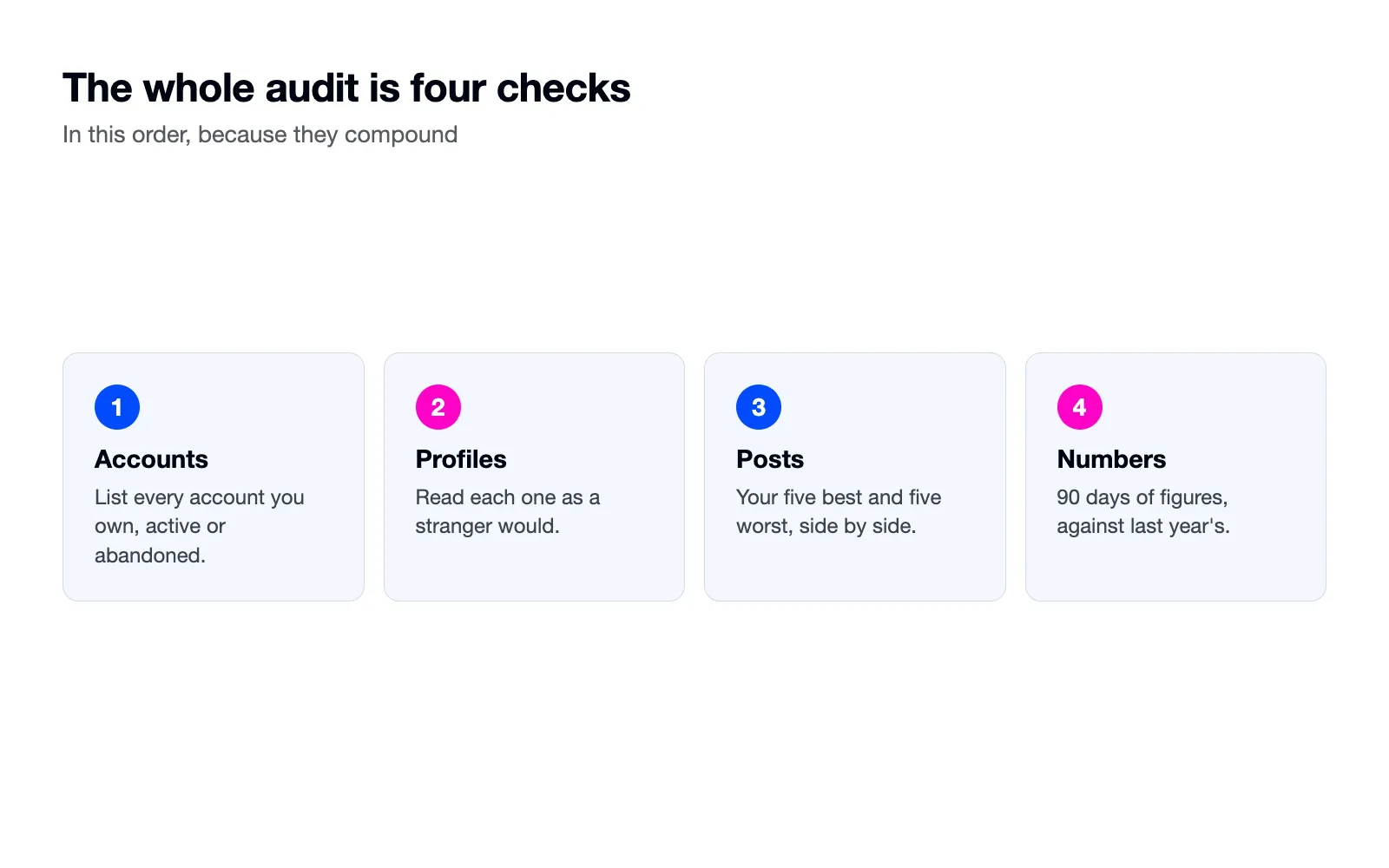
Check one: list every account you own
Write down every account that exists, not every account you use. The X profile from 2019. The Pinterest someone opened during lockdown. The YouTube channel with one video. For each one, note the platform, the handle, the date of the last post, and who holds the login. If nobody knows the login, that is your first finding.
Every live account is a public shopfront, and an abandoned one is a shopfront with last year's opening hours in the window. Decide for each account: keep it and feed it, close it, or park it with a pinned post pointing at the account you actually use. The rule is simple. An account you cannot feed at your chosen cadence does not stay open in its current state.
Check two: read each profile as a stranger
Open each surviving profile as if you had never seen it. Five things to verify. The name is searchable and matches your business. The photo is recognisable at thumbnail size. The bio says what you do and where, in plain words a customer would type. The link works and points somewhere current. The contact options are the ones you actually answer.
Then check the profiles against each other. Same name, same photo, same description of the business everywhere. A customer who finds you on one platform and looks you up on another should have no doubt they found the same shop. Plain searchable wording beats clever wording in every field, and our search guides cover why.
Check three: your five best and five worst posts
Pull your last 90 days of posts and sort them by engagement divided by reach. Read the top five side by side and look for what repeats. A format? A topic? A way of opening? That repetition is your audience telling you what they want more of, in the only language they have.
Now read the bottom five the same way. On the accounts we audit, the bottom five usually share a trait too: announcements nobody asked for, recycled graphics, posts about the business rather than for the customer. The bottom of your own list will have its own habit, and naming it is the point of the exercise.
Finish the check by writing one sentence: our audience keeps X and skips Y. That sentence steers next month better than any trend report.
Check four: 90 days of numbers
Every platform's own analytics will give you five numbers: reach over time, engagement divided by reach, follower change, profile visits, and clicks or messages. Write down the current 90 days, then pull the same period from a year ago if the account is old enough. Year against year matters because seasons move the numbers on their own, and August against May tells you about summer, not about your content.
For Instagram, you have a public benchmark to stand next to: Buffer's 2026 report across 52 million posts puts the median engagement rate near 5.4%, measured by reach. Above that, your content is working and reach is your problem. Below it, engagement is the problem, and reach fixes will not help until the content does.
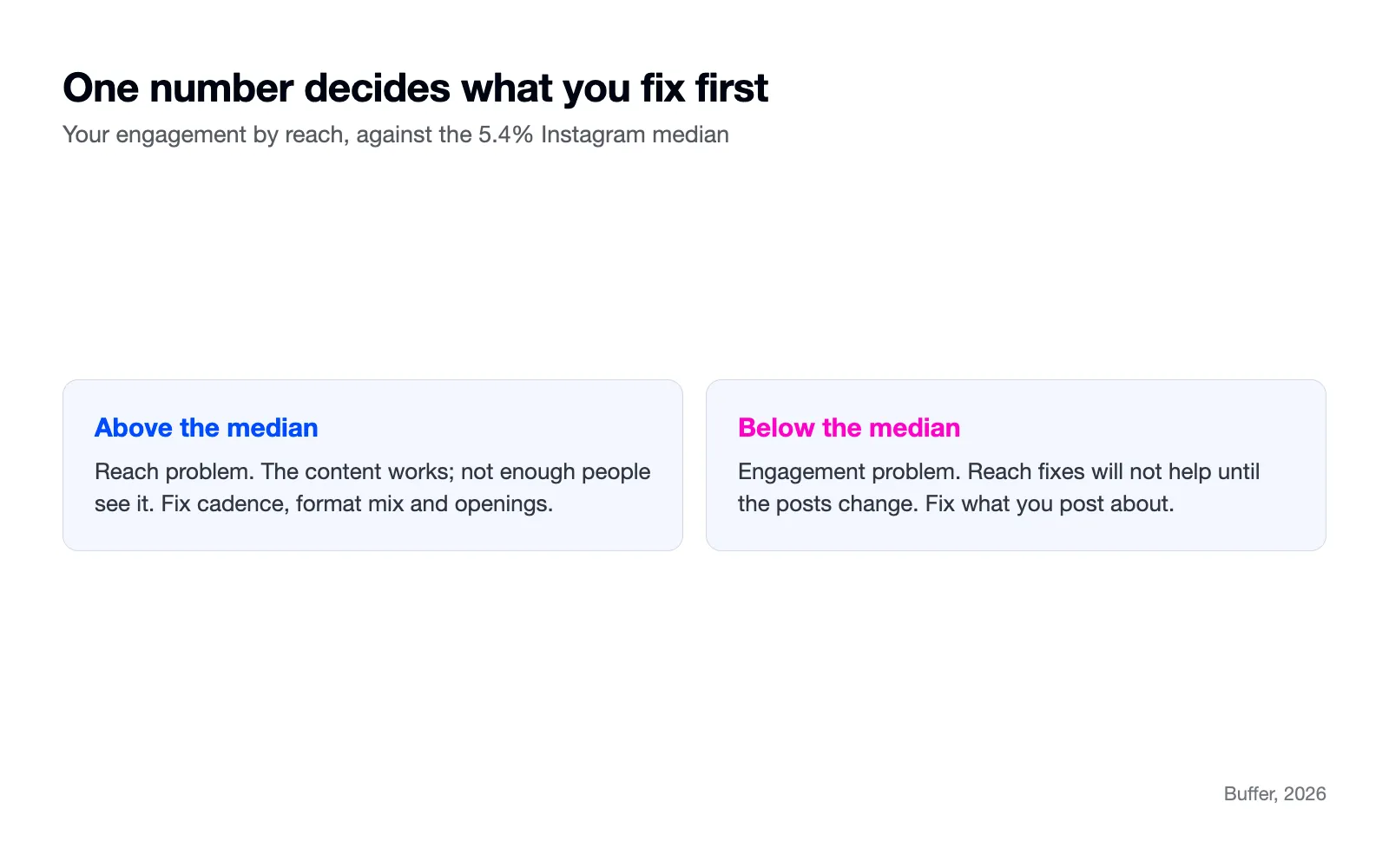
That split is the most useful thing the numbers give you. Reach problems get fixed with cadence, format and openings. Engagement problems get fixed by changing what the posts are about. Most accounts have one of the two, and treating the wrong one wastes a quarter.
The template, in plain text
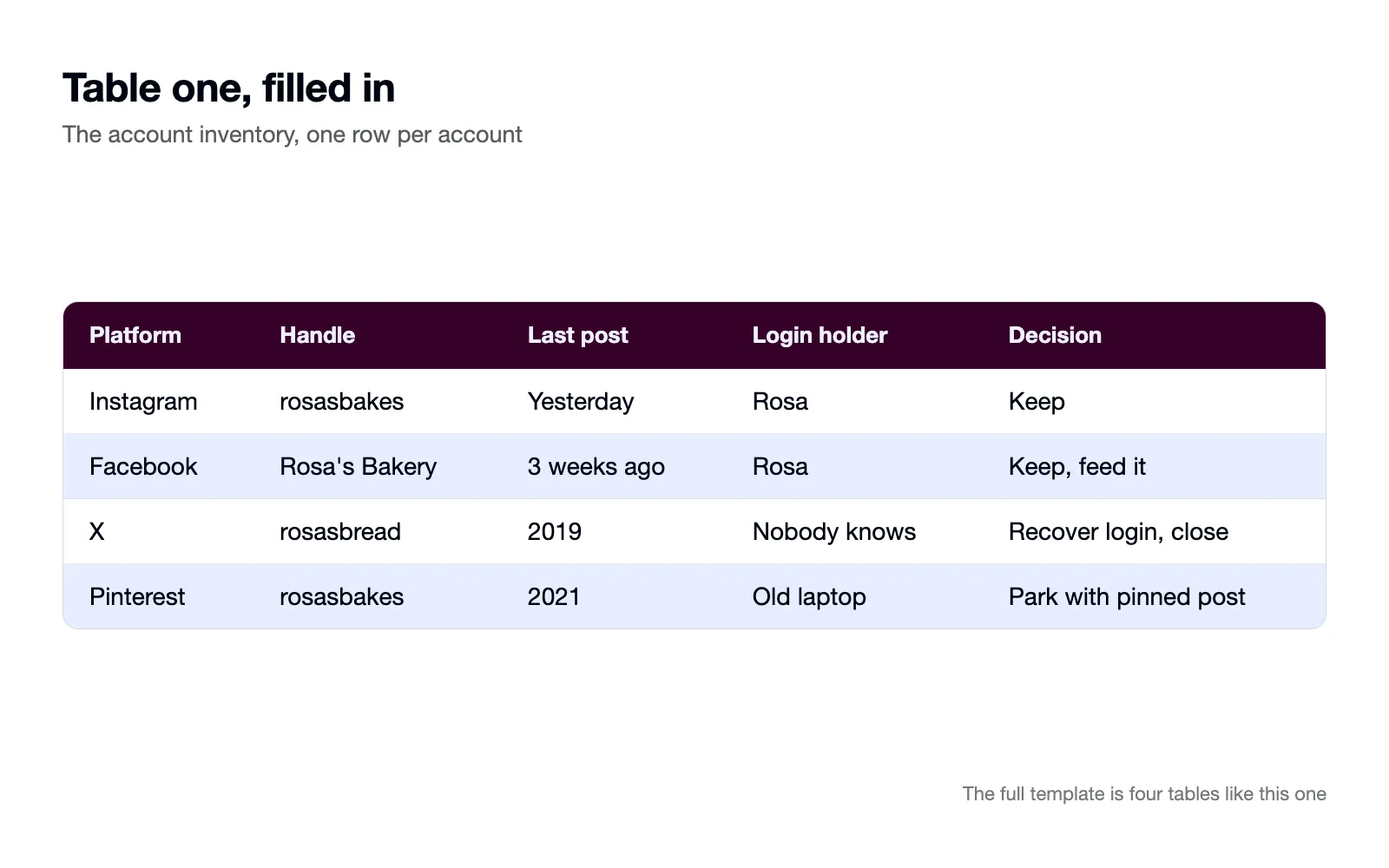
The template is four tables, and a notes app holds them fine. Table one, accounts: platform, handle, last post, login holder, decision. Table two, profiles: one row per account, a column each for name, photo, bio line, link and contact, with a yes or no in every cell. Table three, posts: your top five and bottom five, with a column for what repeats. Table four, numbers: the five figures per platform, this quarter next to the same quarter last year.
One row, filled in, as an example: Instagram, rosasbakes, posted yesterday, login with Rosa, keep. The first table might take ten minutes, and for most businesses it is the first complete list of their accounts that has ever existed.
Copy the tables, fill them in the order above, and the afternoon runs itself. They are boring on purpose. An audit template with twenty tabs is how audits become projects, and projects get postponed.
Turn the findings into a list
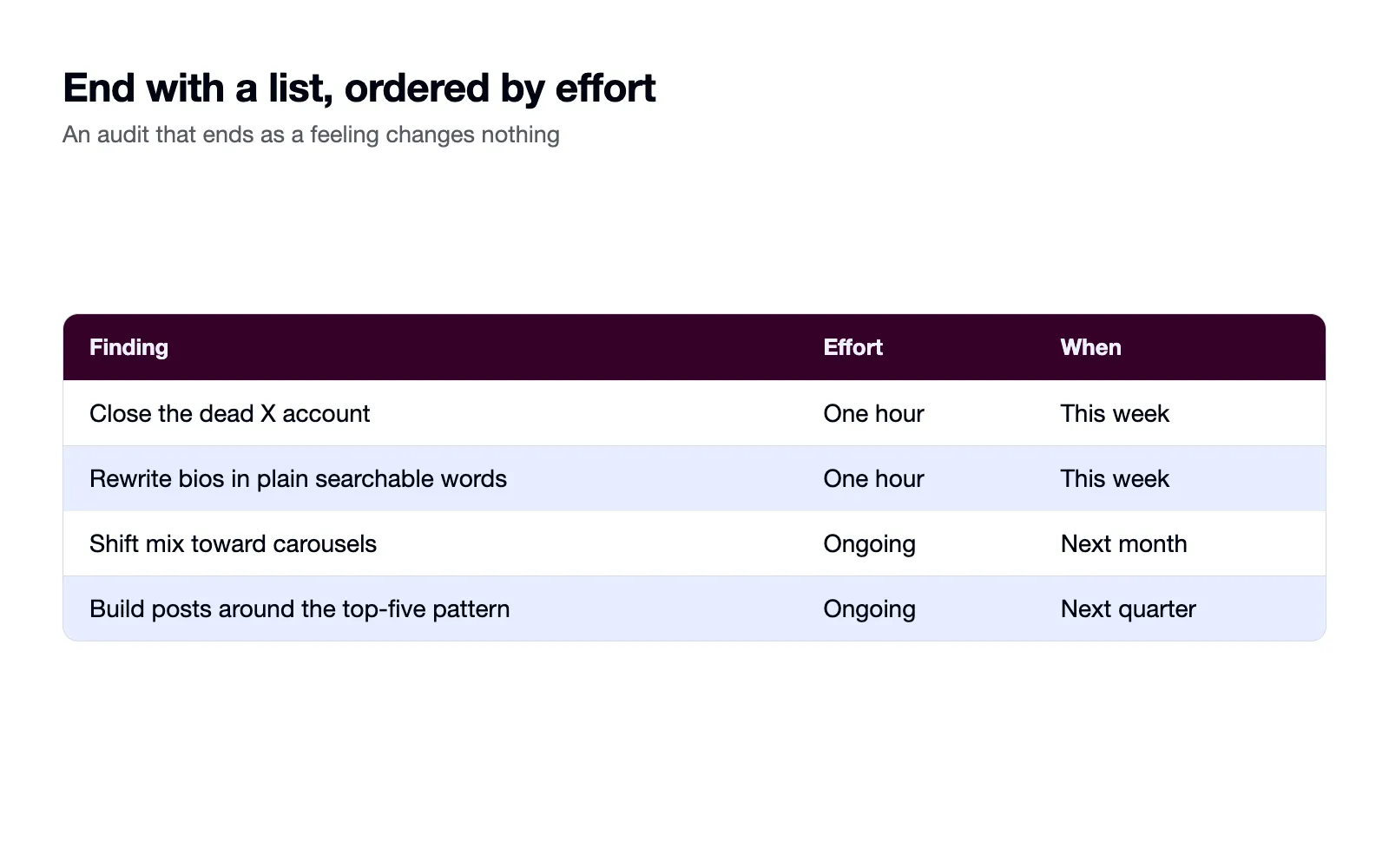
An audit that ends as a feeling changes nothing. End it as a written list, ordered by effort. Closing dead accounts takes an hour. Fixing bios takes an hour. Shifting the format mix starts next month. Rebuilding content around what your top five said is ongoing work. Date the list, put the quick items in this week's diary, and put the slow ones in the content calendar.
Then put a repeat in the diary. Hootsuite's 2026 guidance is a quick check monthly and a full audit quarterly, and we run client accounts on the same rhythm. The first audit finds the mess. The quarterly ones catch drift while it is still cheap to correct.
Findings that skip the queue
Three discoveries ignore the ordering and go first. A login held only by someone who left: recover it today, because you cannot fix an account you cannot enter. An imposter or duplicate account trading on your name: report it to the platform now, since every week it stands it collects your customers. A bio link pointing at a dead page: that one costs sales daily and takes two minutes to fix.
While you are in each inbox, open the message requests folder. Unanswered requests from real customers are the quietest finding an audit turns up, and clearing them is the fastest win on the whole list.
What the DIY version cannot see
Three things, honestly. Your own captions read differently to you than to a stranger, because you know what you meant. Your account only makes full sense next to three competitors, and reading rivals cold is genuinely hard to do about your own trade. And the finding you most need is often the one about the post type you personally love, which is the one you will argue with.
That outside read is the half we sell. If the afternoon version leaves you with a list, work the list. If it leaves you with questions, book our audit and bring your notes, because an audit that starts from your own findings moves faster and goes deeper.

Georgia May
CEO & Founder of Tea & Toast